
Jul 28, 2025
ERP vs Spreadsheets: Which Works for Logistics?
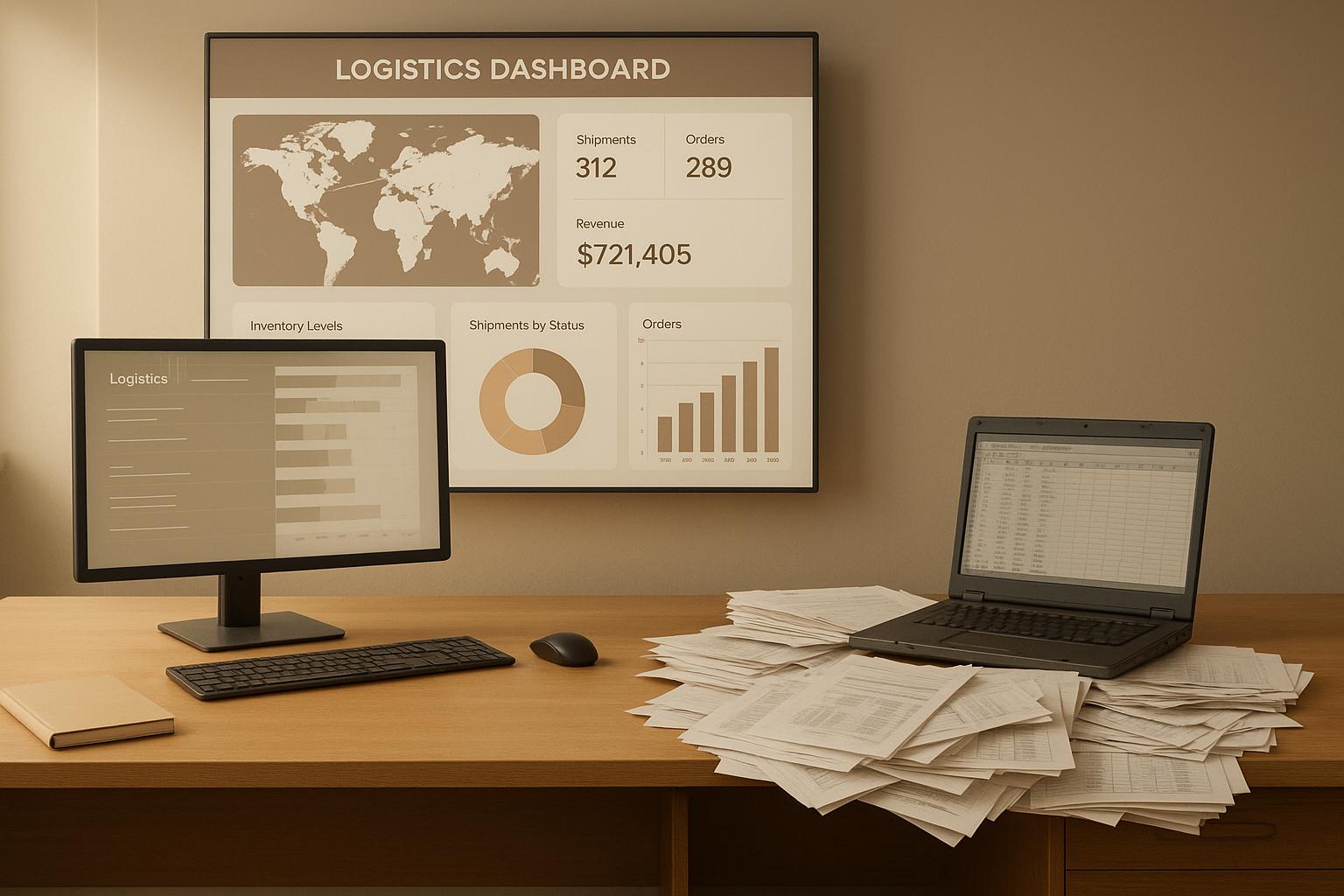
South Africa's logistics sector is under pressure. Crumbling infrastructure, load shedding, cargo theft, and regulatory hurdles make efficient operations challenging. Many logistics companies rely on spreadsheets to manage these complexities, but as businesses grow, spreadsheets often fall short. ERP systems offer a more efficient alternative by centralising data, automating tasks, and improving accuracy.
Key Takeaways:
Spreadsheets: Affordable and easy to use but prone to errors, lack real-time updates, and struggle with complex operations.
ERP Systems: Provide real-time visibility, automation, and scalability but require higher upfront investment and training.
Quick Comparison:
Factor | Spreadsheets | ERP Systems |
|---|---|---|
Cost | Low upfront cost | Higher upfront cost, long-term savings |
Data Accuracy | Prone to manual errors | High accuracy with automation |
Scalability | Limited as operations grow | Easily scales with business needs |
Real-Time Updates | Not available | Immediate access to updated data |
Automation | Minimal | Automates key logistics tasks |
Collaboration | Challenging, prone to data silos | Unified platform for teamwork |
For businesses struggling with inefficiencies, ERP systems are a long-term solution for handling South Africa’s logistics challenges. While spreadsheets work for smaller operations, upgrading to ERP ensures better control, reduced errors, and the ability to grow.
From spreadsheets to smart systems | Muckin' Around Podcast with Springbridge
Spreadsheets in Logistics: Benefits and Problems
Spreadsheets continue to play a key role in South Africa's logistics sector, even as newer tools emerge. Understanding both their strengths and weaknesses is essential for choosing the right tools for logistics operations.
How Logistics Companies Use Spreadsheets
For many logistics companies in South Africa, spreadsheets are a daily staple. Recent data shows that 67.4% of supply chain managers use spreadsheets as part of their supply chain management, and 46% of supply chain experts rely on them as their main operational tool.
Their uses are diverse. From demand forecasting and shipment tracking to inventory management, spreadsheets are a go-to solution. Smaller businesses, in particular, find them helpful for tasks like load consolidation and route planning, as the cost of advanced systems can be prohibitive. Spreadsheets also offer the flexibility to adapt to local challenges, such as adjusting delivery schedules during load shedding or navigating unpredictable conditions on the ground.
This versatility explains their widespread adoption, but it also brings to light the challenges they pose.
Why Spreadsheets Work Well
Spreadsheets remain popular because they are affordable, user-friendly, and require minimal training. They come as part of standard office software packages, eliminating the need for heavy upfront investments in expensive ERP systems. Unlike cloud-based tools, spreadsheets can run on basic hardware and remain functional during load shedding, making them especially practical in South Africa. For small businesses, they offer a cost-effective way to handle tasks like route planning.
Their adaptability allows quick adjustments to operations, making them a convenient choice for many logistics teams. But as businesses expand, these conveniences can quickly turn into limitations.
Where Spreadsheets Fall Short
While spreadsheets are useful, their limitations become glaring as logistics operations grow more complex. Manual errors are a common issue, leading to problems like inaccurate inventory counts, overstocking, or stockouts.
Another major drawback is the lack of real-time data updates, which creates delays in fast-paced logistics environments. Spreadsheets also struggle with scalability - when the number of SKUs exceeds 1,000, their reliability for forecasting drops significantly.
Collaboration is another weak point. Since spreadsheets require frequent manual updates, sharing and maintaining accurate data across multiple users becomes challenging, often compromising data integrity.
Automation is virtually non-existent. Spreadsheets cannot handle tasks like reorder alerts, low-stock notifications, or automated demand forecasting, which are critical for efficient logistics operations.
"Spreadsheets are lousy for complex, n-dimensional problem spaces with lots of moving parts and fast-changing decision-support scenarios. They're especially poor at handling multi-party business collaboration; the undeniable hallmarks of our global supply chain operations today." - Monica Truelsch, SCB Contributor
Spreadsheets also fall short in tracking inventory across multiple locations, leading to inefficiencies in the supply chain. On top of that, their lack of robust security features makes them vulnerable to breaches.
These challenges highlight the need for more integrated and advanced solutions, particularly in complex logistics settings. This sets the stage for exploring ERP systems as a more effective alternative.
ERP Systems in Logistics: What They Can Do
ERP systems are game-changers for logistics, stepping in where spreadsheets fall short. Instead of juggling multiple disconnected files, ERP systems bring everything together on a single platform, streamlining operations to meet the intricate needs of modern logistics.
Main ERP Features for Logistics
ERP systems consolidate all the software needed for core business functions into one shared database. This ensures real-time visibility across operations and eliminates the data silos that often come with spreadsheet-based methods. They automate critical processes like order management, route planning, fleet coordination, and cargo tracking, providing continuous oversight. Additionally, they simplify document management by handling consignment notes, invoices, and waybills, while storing detailed shipment and customer data that can be accessed from anywhere.
On top of that, ERP platforms offer tools like self-service BI, dashboards, and advanced predictive capabilities through AI and IoT integrations. These features enable faster decision-making, with data visualisation through KPIs and intuitive analytics. Predictive analytics, in particular, is a game-changer for demand forecasting and responding quickly to supply chain disruptions.
These capabilities directly tackle the operational hurdles faced by logistics companies in South Africa.
How ERP Helps South African Businesses
ERP systems are well-suited to address challenges unique to South Africa, such as load shedding and complex regulatory requirements. The local ERP software market is expected to hit R3.7 billion by 2025, with businesses spending an average of R141 per employee on ERP solutions. For companies involved in cross-border trade, multi-currency support is critical. ERP systems handle transactions seamlessly across various currencies, including rand and US dollars, while also accommodating different languages and business practices.
When it comes to regulatory compliance, ERP systems simplify the process by automating accounting tasks, generating detailed financial reports, and streamlining adherence to South Africa's tax and customs regulations.
Cloud-based ERP systems are particularly valuable in South Africa, offering mobile access through cellular-connected devices during power outages. Heinrich de Leeuw, Managing Director of SEIDOR in South Africa, highlights the importance of this technology:
"With ERP, wholesalers can avoid the costly pitfalls of overstocking, which ties up capital and storage resources, or understocking, which has the risk of losing sales and customer trust."
ERP systems also use advanced logic to optimise stock levels, analysing past sales data to prevent stockouts and reduce wasted space. This automated approach is a lifeline for South African businesses grappling with supply chain unpredictability.
T-ERP's Logistics Solutions
T-ERP stands out by delivering ERP solutions tailored to the specific needs of South African logistics companies. Founded by Kyle van Rooyen, the company specialises in ERP design, systems consulting, and operational strategies for industries like logistics, mining, and manufacturing. Their focus is on replacing outdated, spreadsheet-heavy processes with custom integrations and automated workflows.
T-ERP’s offerings include API integrations and custom software development starting at R201,499, process automation services from R45,749, subscription-based strategic support at R91,649 per month, and full system overhauls starting at R64,099. These solutions are designed to boost efficiency and streamline operations.
As Heinrich de Leeuw puts it:
"Embracing ERP technology is not just a strategic move; it's essential for wholesalers aiming to thrive in today's competitive landscape."
ERP vs Spreadsheets: Side-by-Side Comparison
What We're Comparing
In South Africa's logistics sector, businesses face some tough choices. Key factors like data accuracy, scalability, collaboration, real-time visibility, automation, and compliance management play a critical role in deciding between ERP systems and spreadsheets. These considerations are especially vital given the unique challenges of operating in the local market.
For South African logistics companies, inefficient inventory management can push operational costs up by 20–30%. With the Africa Continental Free Trade Area (AfCFTA) projected to boost intra-African trade by 52.3% by 2025, adopting the right tools is no longer optional - it's essential for staying competitive.
Heinrich de Leeuw, Managing Director of SEIDOR South Africa, highlights the risks of relying on outdated methods:
"An SMME still relying on spreadsheets for daily tasks runs the risk of falling behind competitors because of inefficient manual processes, high operational costs, greater risk of errors, and limitations to growth potential."
To help you understand the difference, here's a side-by-side look at how ERP systems stack up against spreadsheets.
Comparison Table: ERP vs Spreadsheets
Factor | Spreadsheets | ERP Systems |
|---|---|---|
Data Accuracy | Prone to manual entry errors - over 90% of spreadsheets contain mistakes | High accuracy through centralised data and automated processes |
Scalability | Struggles to handle growth; becomes cumbersome as businesses expand | Scales seamlessly to accommodate larger datasets and growing business demands |
Real-time Data | No real-time updates; delays in decision-making | Provides instant access to up-to-date information |
Collaboration | Causes data silos and version control issues | Encourages teamwork with a unified platform everyone can access |
Automation | Relies heavily on manual input; limited automation | Automates core tasks, speeding up processes by 20–30% |
Inventory Tracking | Struggles with complex inventory scenarios | Advanced tools reduce inventory errors by up to 99% |
Cost Impact | Hidden costs from inefficiencies and errors | Cuts warehousing costs by 15–25% |
The numbers speak for themselves - ERP systems bring efficiency and precision, especially for South Africa's fast-changing logistics sector. For example, ERP adoption can boost operational efficiency by 49%, while advanced inventory tracking can nearly eliminate errors. These improvements are crucial for companies navigating cross-border trade and meeting regulatory demands.
The Panorama Consulting Group sums up ERP's advantage perfectly:
"ERP software creates a single, unified source of truth based on reliable data. There's only one version of information, and all users have access to it in real time."
Additionally, cloud-based ERP systems, which have seen a strong 21% growth rate, add perks like mobile access, making them even more appealing. For South African logistics companies, ERP systems provide the solid infrastructure needed to thrive in a competitive and evolving market.
Moving from Spreadsheets to ERP
When to Make the Switch
Deciding when to transition from spreadsheets to an ERP system can be tricky, but certain red flags signal that your logistics business has outgrown its current tools.
Data scattered across multiple sources makes decision-making difficult. When your information is fragmented across numerous spreadsheets and disconnected systems, it becomes nearly impossible to get a clear picture of your business operations.
Employees spend more time updating data than driving growth. If your team is stuck managing spreadsheets, double-checking information, and fixing errors, instead of focusing on strategic goals, you're not only wasting time but also risking version control issues that can lead to costly mistakes.
Scheduling mistakes disrupt operations. Frequent errors in scheduling can cause missed appointments, delayed operations, and frustrated customers, making it harder to build strong client relationships.
Growth feels out of reach. Without automation and real-time insights, scaling your business - whether it’s expanding your team, offering new services, or entering new markets - becomes a daunting challenge. Older systems often can’t handle the complexities of growth.
Other warning signs include departments working in isolation, relying too heavily on email for day-to-day tasks, complaints from customers about delivery issues and quality, and ongoing inventory mismatches. In some cases, pressure from investors to modernise systems can also push businesses to make the switch.
The numbers back it up. A study by Accenture found that 92% of traditional systems require manual effort to access data, and 33% need custom development just to extract information. These challenges highlight the need for a unified system that streamlines operations and supports growth.
How to Implement ERP Systems
Once you recognise the need for change, a well-organised plan can help you migrate from spreadsheets to an ERP system while minimising disruptions. By leveraging automation and real-time tracking, you can ensure a smoother transition.
Start with a detailed migration plan. Identify your current challenges and set clear goals for what you want the ERP system to achieve. Assess your existing processes and define the key performance indicators (KPIs) you'll use to measure success.
Adopt a phased rollout. Instead of switching everything at once, transition gradually by implementing the system in stages, such as by department or module. This approach reduces risk, allows for testing, and gives your team time to adapt.
Thoroughly clean and map your data. Before migration, eliminate duplicate entries, fix inconsistencies, and standardise data formats. Create a detailed mapping guide to ensure a seamless transfer of data from your spreadsheets to the ERP system.
Verify the data after migration. Use incremental data loading techniques to transfer information in smaller, manageable batches. After migration, validate the data to ensure everything has been accurately transferred.
Prioritise training and change management. Develop training programmes tailored to different roles within your team. Emphasise how the new system will benefit them and provide ongoing support to address concerns and resistance. Clear communication is key to a smoother transition.
For logistics businesses in South Africa, solutions like T-ERP offer tailored implementation packages, including custom integrations, automation, and team training to meet industry-specific needs.
Choosing the right ERP vendor is critical. Look for providers with experience in logistics, a strong track record of support, and systems designed to grow alongside your business. With careful planning, clean data, and a step-by-step approach, you can upgrade your systems without disrupting daily operations.
Investing in ERP not only transforms your business processes but also sets the stage for better efficiency, smarter decision-making, and the confidence to scale your business effectively.
Conclusion: Why ERP Makes Sense for Logistics
Spreadsheets may work for very small businesses with straightforward operations, but as companies grow, their limitations quickly become apparent. In fact, over 88% of Microsoft Excel spreadsheets have errors in at least 1% of their formulas. These errors can lead to unreliable data, causing issues in critical areas like inventory management, scheduling, and customer deliveries.
Real-world examples from South Africa highlight how ERP systems address these challenges. Take Body Motion, a local sportswear and scrubs manufacturer. They transitioned from Excel to an ERP system and gained real-time visibility across their inventory, production, and orders, while also eliminating the problem of double purchasing. Similarly, QMH, a logistics company, managed to cut their reporting time from hours to mere minutes by adopting an ERP solution.
The financial benefits of ERP systems are hard to ignore. For instance, cloud-based ERP solutions can cost up to 50% less than on-premise systems over a four-year period for a 100-employee company. Entry-level cloud solutions are available for around R50,000 annually. Additionally, ERP systems have been shown to help manufacturing companies reduce operational costs by 23% and administration costs by 22%.
For logistics companies in South Africa, dealing with challenges such as fluctuating exchange rates, energy supply issues, and the need to meet global standards, ERP systems provide a level of stability and advanced functionality that spreadsheets simply cannot. AI-enabled supply chains, for example, are 67% more efficient than those without AI, giving businesses a significant competitive advantage. These capabilities make it clear why upgrading from spreadsheets is not just beneficial - it’s essential.
Making the Right Choice for Your Business
Choosing the right solution depends on your current challenges and future goals. If your business struggles with scattered data, excessive time spent updating spreadsheets, or frequent scheduling errors that disrupt operations, it’s a strong indicator that it’s time to consider ERP.
"An SMME still relying on spreadsheets for daily tasks runs the risk of falling behind competitors because of inefficient manual processes, high operational costs, greater risk of errors, and limitations to growth potential."
Heinrich de Leeuw, Managing Director, SEIDOR in South Africa
The good news is that implementing an ERP system has become more accessible. With 83% of South African enterprises increasing their investment in cloud-based solutions, and with implementation timelines now 20–30% faster, adopting ERP is more straightforward and cost-effective than ever.
ERP systems offer the tools to future-proof your logistics operations. They provide real-time data visibility, automate manual processes, and offer scalability to support growth. By centralising data and eliminating silos, ERP ensures the accuracy and control needed to stay competitive in today’s market. For South African logistics companies navigating local challenges and cost pressures, this integrated approach is crucial for long-term success.
For businesses ready to move past the limitations of spreadsheets, options like T-ERP offer tailored packages designed specifically for the logistics industry. These include custom integrations, automation capabilities, and comprehensive team training to ensure a smooth transition.
The real question isn’t whether ERP makes sense for logistics - it’s whether your business can afford to stick with spreadsheets while competitors embrace the advantages of integrated, automated systems.
FAQs
What challenges do South African logistics companies face with spreadsheets, and how can ERP systems solve them?
Many logistics companies across South Africa face challenges like poor visibility, frequent data errors, and tedious manual processes when relying on spreadsheets. These issues can slow down decision-making and make it harder to scale operations smoothly.
ERP systems provide a smarter alternative by offering real-time data access, automated workflows, and precise tracking. This not only boosts efficiency and reduces mistakes but also enables more informed decisions. On top of that, ERP systems bring together essential logistics functions such as inventory management, demand forecasting, and cost control, making them a dependable and scalable solution for the industry.
Why are ERP systems better than spreadsheets for improving collaboration and data accuracy in logistics?
ERP systems make teamwork easier by allowing real-time data sharing across teams and with external partners. Unlike spreadsheets, which can be isolated and need constant manual updates, ERP platforms centralise all information. This ensures everyone is working from the same, most current data, improving coordination throughout logistics operations.
These systems also boost data accuracy by automating tasks like data entry and validation. This cuts down on the errors and inconsistencies often seen with manual methods. By bringing together functions like inventory management, demand forecasting, and workflow tracking, ERP systems offer a dependable and efficient way to handle logistics.
What should logistics companies evaluate when deciding to move from spreadsheets to an ERP system?
When logistics companies think about moving from spreadsheets to an ERP system, there are a few important aspects to weigh up:
Real-time data needs: Does your business need instant visibility into inventory, shipments, or operations to stay on top of things?
Scalability: Are your current tools struggling to keep pace with your business growth and its increasing demands?
Automation and integration: Could automating repetitive tasks and connecting workflows help save time and minimise errors?
Data accuracy: Are manual errors or inconsistencies in spreadsheets creating risks in your decision-making process?
Cost-effectiveness: While ERP systems might involve upfront costs, think about the potential long-term savings through better efficiency and fewer mistakes.
For South African businesses, there’s an added benefit: ERP systems can often be tailored to handle R-based financials, metric units, and local compliance requirements. This localisation can make the transition even more valuable, aligning the system with regional needs and standards.